Introduction
In the last five years, hotels worldwide – from independent boutiques to major chains – have adopted performant, reliable point-of-sale (POS) systems featuring digital room service menus. These systems allow guests to order food and amenities via in-room tablets or their own mobile devices, rather than calling on the phone. The result has been a transformation of room service from a slow, manual process into a convenient digital experience. Hotels report that this shift has increased guest convenience and order frequency, improved operational efficiency, boosted revenue and profit margins, and enhanced customer satisfaction (often leading to higher loyalty and retention). The following report examines global case studies demonstrating these benefits, with data and metrics where available.
Enhancing Guest Convenience and Order Frequency
Digital menus and mobile ordering apps have greatly increased guest convenience, which in turn drives higher usage of room service. According to one industry study, 68% of guests who order room service do so primarily for convenience . By letting guests browse an interactive menu and submit orders instantly, modern POS-integrated apps remove the friction of phone orders. Guests can order at any hour with a few taps, without waiting on hold or repeating their requests – a feature especially appreciated by tech-savvy travelers. In-room tablets and QR code ordering have made room service more accessible, encouraging guests to use it more frequently than before.
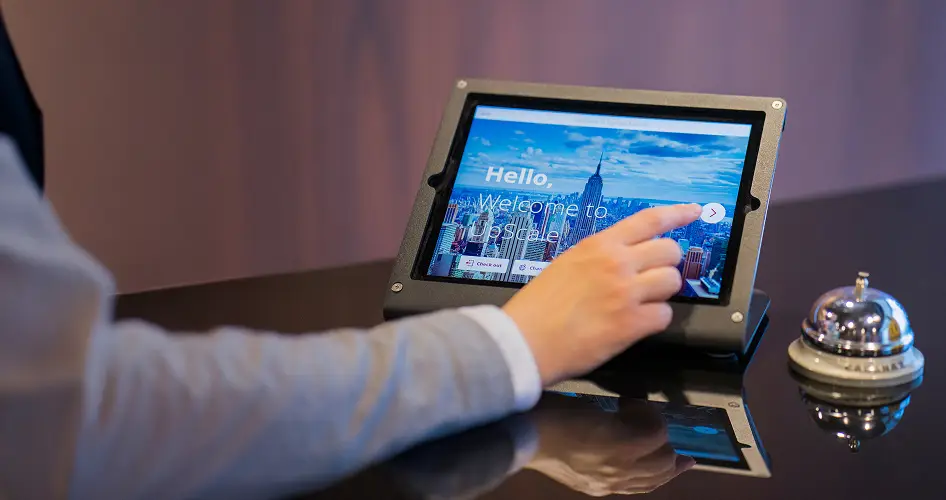
Mobile ordering apps let hotel guests easily request room service from their own devices, improving convenience and encouraging more frequent orders.
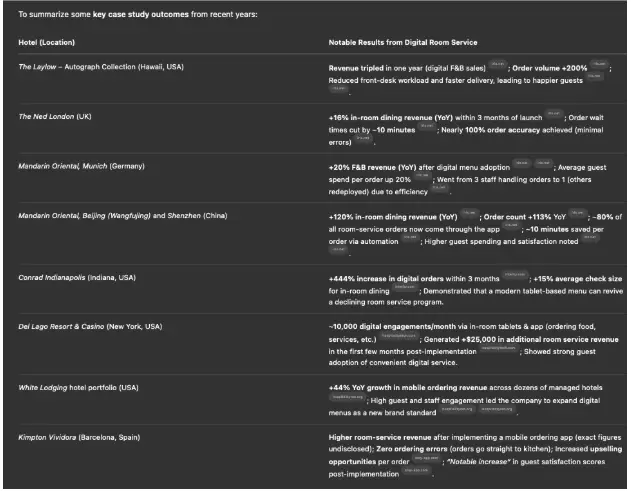
Real-world examples illustrate how convenience boosts order volumes. At Del Lago Resort & Casino (USA), providing guests with bedside tablets and a mobile app led to approximately 10,000 digital guest engagements per month, including room service requests, and generated over $25,000 in additional room service revenue shortly after launch . The resort’s management noted that placing tablet devices on nightstands made it “extremely convenient” for guests to order room service, request valet, or ask for amenities with just a few taps . Similarly, Mandarin Oriental’s luxury hotels in China found that about 80% of all in-room dining orders are now placed through their mobile app, reflecting guests’ strong preference for a digital self-service option . The convenience of on-demand ordering means guests are more likely to indulge in late-night snacks or impromptu orders – for example, one digital menu provider reports its hotel clients see order revenues increase over 90% year-on-year as mobile adoption grows .
By making room service as easy as online shopping, hotels also recapture revenue that might otherwise be lost to outside food delivery services. At the Valia Hotel in Bangkok, introducing a contactless dining platform not only streamlined operations, it “increased room service orders” by keeping guests from turning to external food delivery apps . In other words, an intuitive digital room service POS helps keep guest spending on-property, boosting the hotel’s F&B revenue while offering superior convenience.
Improving Operational Efficiency and Speed
Hotels implementing integrated room service POS systems have reported major gains in operational efficiency, benefiting both staff and guests. Because digital orders go straight to the kitchen or bar (and into the POS system) with no phone intermediary, service is faster and labor is used more effectively. For example, The Ned London – a luxury hotel and club in the UK – deployed a mobile ordering app for in-room dining and saw average order delivery times cut by up to 10 minutes, thanks to orders being transmitted instantly and accurately to the kitchen . In addition, automation has virtually eliminated ordering errors; The Ned achieved “almost 100%” order accuracy after launch, significantly reducing mistakes compared to manual phone orders . Staff no longer need to constantly answer phones and re-enter orders, freeing them to focus on food preparation and personalized guest service. The hotel’s Head of In-Room Dining noted that the app “enhances accuracy and efficiency in ordering, while boosting average spend per head and revenue”, and it “significantly improved the guest journey, allowing them to order anytime, anywhere… with ease” .
Other hotels echo these efficiency improvements. At Mandarin Oriental, Munich, management reported that their digital ordering app allowed them to reduce dedicated room-service staff from three employees down to one, since far fewer orders come through the phone now . The two freed-up staff members were reassigned to other guest services, improving productivity . The remaining room-service attendant can handle deliveries while the system takes care of order capture and routing. Fewer manual steps also mean faster turnaround and fewer errors – the Munich team notes that orders are processed quicker and with much higher accuracy than before . In Mandarin Oriental’s Beijing and Shenzhen hotels, the integration of the IRIS mobile ordering platform with back-end systems like HotSOS has automated service request ticketing; this saved “on average 10 minutes per request” in fulfillment time and enabled staff to handle higher volume more smoothly .
Streamlining the ordering process reduces staff workload and wait times, improving service speed overall. At The Laylow, Autograph Collection (Hawaii), implementing a mobile ordering solution meant orders go straight from the guest’s device to the POS and then to the kitchen, with no phone call or paper ticket . This eliminated redundant tasks and allowed the hotel’s front desk and restaurant teams to operate more efficiently. Laylow’s managers observed that with fewer manual processes, the front desk and kitchen staff were “significantly less” burdened by room service coordination, enabling faster service and more attention to guests on property . In essence, digital room service systems act like an extra set of hands – taking orders, dispatching them to the right department, and handling payments automatically – which lets the hotel serve more guests without adding extra staff. White Lodging, a company managing dozens of hotel properties in the U.S., described mobile ordering as a “critical ancillary revenue driver” and noted that strong staff training and an intuitive platform were key to achieving a 44% year-on-year growth in mobile ordering revenue across their hotels . By optimizing the platform’s user interface and images, White Lodging ensured high guest adoption, and by training employees they ensured smooth operations – demonstrating that technology plus process alignment leads to both revenue and efficiency gains .
Boosting Revenue and Profit Margins with Digital Ordering
Across the board, hotels report that making room service more accessible and efficient has translated into higher revenues and improved profit margins. The increased order frequency and larger average order sizes directly drive F&B revenue upward. Many properties have seen double-digit (or higher) growth in room service sales after rolling out digital ordering:
- Higher average checks through upselling: Digital menus often present enticing photos and suggest add-ons (e.g. sides, desserts, drinks) during the ordering flow. This tends to increase how much each guest spends. Industry research shows that consumers often place larger orders via mobile interfaces, especially when menus include images and prompts . Hotels using these systems have seen average transaction values rise 20–40% on the platform . For instance, Intelity noted that after implementing in-room tablets, the Conrad Indianapolis hotel saw the average in-room dining check increase by nearly 15% alongside a surge in order volume . The F&B director at Mandarin Oriental Munich similarly reported a 20% increase in guest spend per order year-on-year, attributing it to the digital menu’s ability to showcase a diverse range of items and upsell extras in a compelling way . Guests often feel more comfortable indulging in upgrades when ordering digitally, since the app can gently encourage extras (“Would you like fries with that?”) without any pressure.
More orders and higher room service usage: The convenience factor has led to significantly more orders being placed overall, which directly boosts revenue. A dramatic example comes from Conrad Indianapolis, where after just three months of launching Intelity’s in-room ordering tablets, digital in-room dining orders increased by 444% compared to the old phone-based system . The Laylow Waikiki saw its year-on-year F&B revenue triple after introducing mobile ordering – an outcome of both higher check sizes and a 200%+ jump in the volume of orders as guests ordered more frequently throughout their stay . At Mandarin Oriental Wangfujing (Beijing), in-suite dining orders grew by 113% year-on-year, leading to a 120% increase in in-room dining revenue after adopting a digital ordering app . Even in a luxury hotel with traditionally strong service, the ease of ordering via smartphone unlocked a new level of sales. And in London, The Ned’s mobile app drove a 16% uplift in F&B revenue within the first three months of deployment , a notable gain for an already high-volume operation. These cases show that when room service is just a tap away, guests use it much more often, turning a once under-utilized amenity into a robust revenue center.
Each of these case studies – spanning large luxury brands and independent hotels – confirms that digital room service platforms can substantially boost F&B revenue. The revenue gains flow directly to the bottom line, especially since these systems also control labor costs (as fewer staff are needed to take orders or chase payments). Some hotels have reported profit margin increases as a result of higher room service sales without a proportional rise in expenses, though exact profit figures are often proprietary. Nevertheless, the consistent theme is that a performant POS with digital ordering adds new revenue streams (or revives underperforming ones) at high margin, given that room service items typically have healthy markups and now face greater demand.
Elevating Customer Satisfaction and Retention
Implementing a modern room service ordering system not only drives revenue – it also tends to delight guests, leading to higher satisfaction ratings and loyalty. By putting the guest in control (order what you want, when you want it, with real-time updates), these digital solutions enhance the overall experience of the stay. Guests appreciate the convenience and transparency: no more waiting on hold, no misheard orders, and clear information about menu options and order status.
Hotels have seen improvements in guest satisfaction scores and reviews after adopting such technology. For example, the General Manager of Kimpton Vividora Barcelona noted that the hotel experienced a “very versatile [digital solution]; Ordering has increased our revenue… and with Instant Feedback, we identify areas for improvement in time.” More importantly, guest feedback became more positive, and management observed a “notable increase in guest satisfaction” after rolling out the mobile ordering and feedback tools . In Asia, Mandarin Oriental’s IT Director for China reported that the IRIS app “helped us improve our levels of service, elevate the guest experience and boost our in-room F&B revenue to new levels”, remarking that embracing guests’ mobile-first expectations “has invariably led to higher rates of guest spending as well as increased guest satisfaction.” He added that digital convenience contributes to loyalty: the app has “boosted guest satisfaction and loyalty”, showing that happy customers are more likely to become repeat guests .
Crucially, faster, error-free service leads to happier guests. The Ned’s team observed that with mobile ordering, their staff could provide “even more focused, attentive and high-quality service” since they weren’t tied up on the phone, and guests in turn enjoyed a smoother experience . Many hotels also integrate guest feedback modules or quick surveys into the digital platform, allowing issues to be identified and resolved before the guest checks out – further improving satisfaction. For instance, Kimpton Vividora uses “Instant Feedback” in its app to catch any negative experiences in real time, which has helped maintain high service quality .
Better satisfaction directly supports customer retention. A guest who finds it easy to get a meal or extra towels at any hour (and gets it promptly) is more likely to give positive reviews and return in the future. Some properties have explicitly linked their digital service to loyalty gains – for example, Mandarin Oriental’s app includes a guest messaging and request feature that eliminates language barriers, which international guests love, thereby strengthening their loyalty to the brand . By exceeding modern guest expectations (for on-demand, contactless service), hotels position themselves as innovative and guest-centric, which can drive repeat bookings and brand loyalty in the long run.
Conclusion
The case studies from 2020–2025 consistently show that hotels leveraging a reliable POS with digital room service ordering see multifaceted benefits. Guests enjoy greater convenience, prompting them to order room service more often and spend more per order. In turn, hotels experience higher room service revenue and healthier profit margins, as well as a more efficient operation that can do more with the same or fewer staff. Importantly, the guest experience improves – faster service and easy ordering lead to higher satisfaction, which bodes well for positive reviews and customer retention. This trend spans independent boutique hotels and large chains alike, across North America, Europe, and Asia. As one hospitality tech report noted, nearly 96% of hoteliers are investing in contactless services to meet guest expectations in the coming years . Digital room service menus are a prime example of this shift, transforming room service from a cumbersome amenity into a convenient, profitable, and guest-pleasing feature. For hotel owners, the takeaway is clear: a performant digital room service POS system is not just a tech upgrade – it’s a strategic investment that drives revenue growth, operational excellence, and stronger guest loyalty .
Ultimately, whether it’s an independent hotel or a global chain, those who have embraced digital room service ordering have gained a competitive edge – delivering the kind of seamless service that modern guests value, while reaping the financial rewards of higher sales and efficiency. The result is a win-win scenario: guests get the convenience and quality they desire, and hoteliers enjoy increased revenues, happier customers, and improved retention rates.
Sources: The above analysis is based on various hospitality case studies, industry reports, and press releases from 2018–2025, including Hospitality Technology and Hotel Online news, vendor case studies (IRIS, Intelity, STAY, Vouch), and statements from hotel management in the U.S., Europe, and Asia. All data points and quotations are referenced from these sources for accuracy.
https://www.iris.net/articles/the-ned-london
https://hospitalitytech.com/ned-boosts-room-dining-revenue-16-new-iris-mobile-ordering-platform
https://www.hotel-online.com/news/the-ned-chooses-iris-for-seamless-mobile-ordering-smarter-service-and-stronger-revenue-performance
https://www.iris.net/articles/mandarin-oriental-beijing-shenzhen
https://www.iris.net/articles/mandarin-oriental-munich
https://www.iris.net/articles/the-laylow-autograph-case-study
https://www.iris.net/articles/white-lodging-hotels-mobile-ordering
https://www.hospitalitynet.org/news/4129437.html
https://www.hotelmanagement.net/tech/white-lodging-expands-partnership-iris-enhance-digital-ordering
https://www.hotel-online.com/news/iris-delivers-44-growth-in-mobile-ordering-revenue-for-white-lodging
https://www.iris.net/articles/hei-hotels-resorts-mobile-ordering
https://www.stay-app.com/customers/kimpton-vividora
https://hoteltechreport.com/success-stories/food-and-beverage/saba-hospitality/amora-hotel-jamison-sydney
SABA Hospitality’s Mobile Ordering and Digital Compendium at InterContinental Phu Quoc
https://www.iris.net/
https://www.stay-app.com/mobile-ordering
https://www.stay-app.com/integrations/simphony-pos
https://www.oracle.com/news/announcement/oracle-hospitality-in-2025-consumer-research-study-2022-06-01/
https://www.oracle.com/a/ocom/docs/industries/hospitality/hospitality-industry-trends-for-2025.pdf
https://www.hospitalitynet.org/news/4110830.html